The demo was never the hard part: who stays until it runs
Forward deployed engineer openings are up 4.6x in a year. A presales view on what the role really changes: not the title, but who owns production.

I’ve spent most of my working life on the selling side of enterprise technology, in presales and solutions architecture. So when one of the fastest-growing engineering roles turns out to look a lot like mine, I pay attention.
It’s called a forward deployed engineer, or FDE. The short version: you sit with the customer until the thing actually runs on their data. Not on the slide. Not in the sandbox. On their data, in their world.
The difference from my job is one line. You don’t get to leave after the demo.
What the numbers say, and what they don’t
Lenny Rachitsky’s late 2026 job market report, built on TrueUp’s openings data, has a paragraph on this that stopped me. Historically there were only a few dozen open FDE roles, mostly at Palantir. Openings started climbing in 2025 and are, in his words, “up 4.6x in the past year alone”. There are around 1,500 open FDE roles at tech companies now.
He also notes that security engineering is one of the fastest-growing specialties, “right behind FDEs”.
Two caveats matter, and Lenny makes the first one himself. Some of that growth is “other job categories, like ‘sales engineer,’ being rebranded as ‘FDE.’” And these are openings, not hires. A job ad is a signal of intent, not proof that anyone was hired.
So I wouldn’t read this as “presales is dead, long live the FDE”. I’d read it as the market putting a name and a budget on a gap many of us have been working around for years.
What an FDE actually is
Palantir popularised the role, so their description is the fairest place to start. A Palantir engineer writing on the company blog puts it simply: a traditional software engineer builds “a single capability that can be used for many customers”, while forward deployed engineers focus on “enabling many capabilities for a single customer”.
Another Palantir post adds the part I care most about: “We are there with the users when the applications go live.”
That’s it. That’s the whole idea. Many vendors have someone who designs the solution. Fewer have someone who is still there when it goes live, and even fewer when it breaks the following Tuesday.
The demo was never the hard part
My first consulting job, in 2008 with Soluciones in Chile, was a big business intelligence project for a telco: requirements, KPIs, connecting the data, reports and dashboards.
Even then, the real work was making it run in the client’s world, not the demo. A demo runs on clean data, with friendly definitions and an admin account that can see everything. Production runs on the data the business actually has, with the permissions it actually grants, and with three teams who each mean something different by “active customer”.
Almost twenty years later, with AI in the middle of every conversation, that hasn’t changed. If anything, it’s sharper. An agent that looks brilliant on a curated dataset can fall over the moment it meets a real entitlement model, a missing field or a definition two departments have argued about for a decade. Dirty data, permissions and definitions are still where the work is.
Rebranded consulting? Partly
Some people call FDE rebranded consulting. Fair enough. Some of it is. The rebranding caveat is in the data itself.
But it helps to look at where each role usually stops.
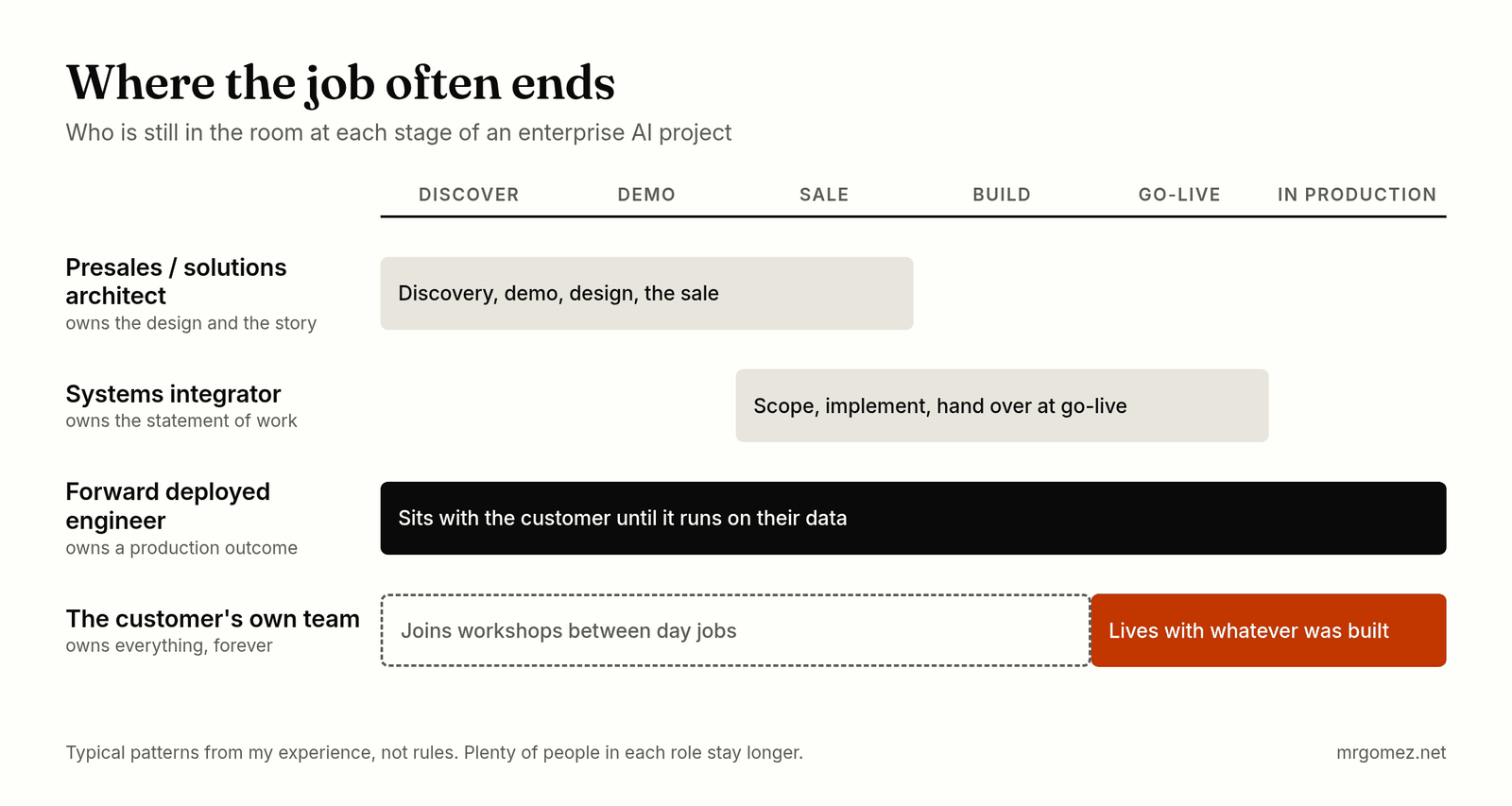
These are patterns, not rules. I know presales people who stay for months after the signature, and integrators who become a client’s most trusted engineers. But the incentives usually look like this:
- Presales and solutions architects often end at the design, or the sale. We own the architecture and the story. We rarely own production.
- Systems integrators often implement to a statement of work, then hand back at go-live. They own the implementation, then usually a handover.
- Forward deployed engineers, done properly, own a production outcome. Not a deliverable. An outcome.
And the customer’s own team is the only one there for the whole journey. They live with whatever gets built long after everyone else has moved on.
The difference I care about isn’t the title. It’s who owns production: who can commit code in the customer’s environment, and who is still there when it breaks.
Why this is happening now
Here’s my read, and it is a read, not a finding.
AI made the demo cheap. Anyone can put together an impressive agent on a clean dataset in an afternoon. When the demo becomes cheap, it stops being the differentiator. The hard part, and the valuable part, moves to the last mile: the data, the permissions, the definitions, the edge cases and the people.
Buyers have noticed. After enough pilots that impressed the steering committee and never reached production, “who stays until it runs?” becomes a much better question than “can I see a demo?”.
That’s also why I don’t think this is bad news for presales. The best solutions engineers I’ve worked with already behave this way. They learn the customer’s data before the first workshop. They ask awkward questions about ownership early. They care whether the thing worked six months later, not just whether the deal closed. The FDE label gives that behaviour a job description.
What I’d tell another practitioner
If you work in presales or solutions architecture:
- Learn the customer’s data and processes, not just the product. The product knowledge gets you the meeting. The data knowledge gets you production.
- Own one production outcome, not a deck. Pick one use case and follow it all the way into the customer’s environment, even if nobody asked you to.
- Write down what “done” means before you start. A finished task, not a finished demo. If you can’t describe done in a sentence the customer agrees with, you’re not ready to build.
If you’re buying:
- Ask who stays until it runs. And who is accountable when it doesn’t.
- Ask to see production, not just a demo. A reference customer running it on their own data tells you more than any slide.
- Plan for your own team. Whoever the vendor sends will leave eventually. Make sure someone on your side learns enough to own what gets built.
The demo was never the hard part. It was just the part we were paid to show.
So here’s my question for anyone in presales or solutions architecture: does the FDE role feel like the job you already do, or like a different one?
~ Mr. Gómez
Sources. Lenny Rachitsky, “State of the tech job market: late 2026”, Lenny’s Newsletter, 10 November 2026, using TrueUp openings data. Palantir Blog, “A day in the life of a Palantir Forward Deployed Software Engineer”, 2 November 2020. Palantir Blog, “Who Wants to be a Delta?”, 21 October 2021. Views are my own.