When the token bill is thirty times payroll
One ten-person company says it spends 30 times its payroll on AI tokens. What that number should change in your business case.
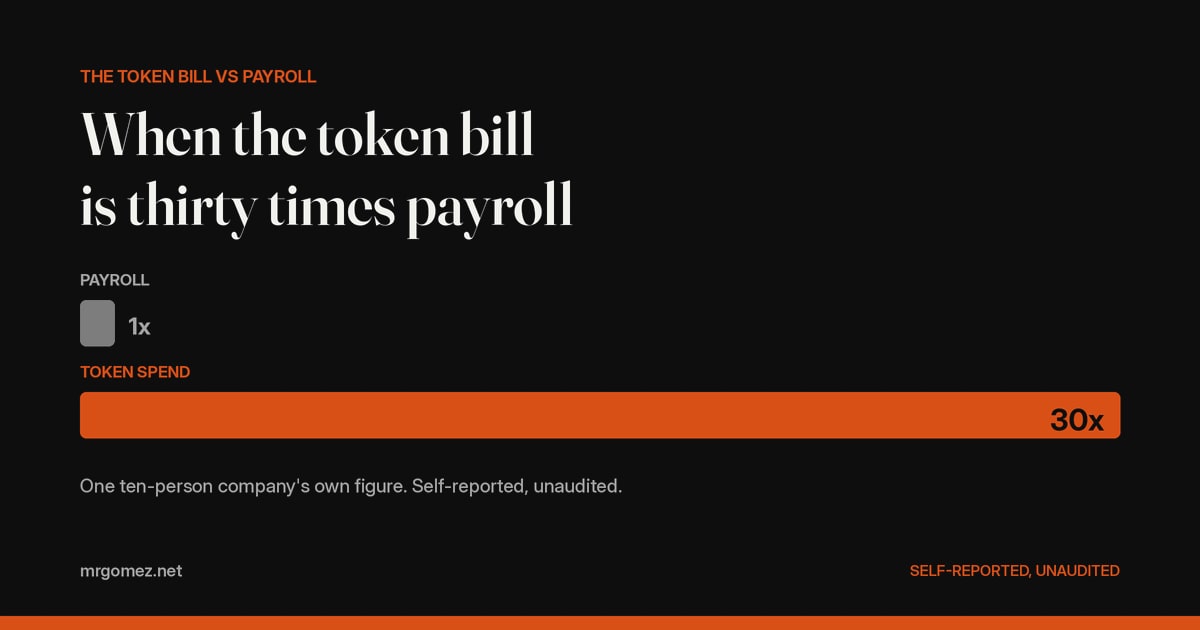
Thirty times payroll. That is the number that stopped me this week.
A ten-person company spent $3.1 million on AI tokens last month. In the same thirty days, its permanent fleet of agents shipped 77,000 substantial changes, about 108 an hour, around the clock. Payroll for ten people does not come close.
The compute line has become the big line, and most finance functions do not know what to do with it.
What the number actually says
The company is Spawn, and the founder, Jacob Sansbury, published the figures himself on 29 October, in an essay he called How I Built the Most AI-Pilled Company in the World.
Ten people. One token bill, and the token bill wins by a factor of thirty. The agents own areas of the business outright: the engine, finance, bug triage, deploys. They fix the errors users hit, verify their own work and ship straight to production.
Payroll is the most disciplined process in any organisation: forecast, budget owner, pay cycle, audit. Adding a head takes a month of argument and a signature.
Token spend has none of that. It arrives on a card on file, or on an invoice that lands mid-month and gets coded to IT. Nobody forecast it, because it was not a line when budgets were set.
The organisation has a mature control system for people and none for compute. The second column is growing.
The caveats, said plainly
Before anyone turns this into a playbook, some honesty.
This is a founder’s account of his own company. Every number is self-reported and unaudited, and all of it comes from the person with the most to gain from it looking impressive.
The essay publishes no revenue, no margins and no customer numbers. Nobody, including me, can say whether any of this makes money. You can spend thirty times payroll and still lose money on every unit you ship.
He also reports a revert rate of about 0.9% of changes over a year, the number I would want audited first.
Then there is the domain. A game world tolerates breakage in ways payments, healthcare or infrastructure do not. A bad deploy in a game is a bad afternoon and a patch. A bad deploy in a payment system is a reconciliation problem and a phone call from a regulator.
So I am not offering thirty times as a benchmark. It is not a prediction and not something to copy. What it does is make a question visible that the rest of us have avoided.
Meanwhile, in most enterprises
Most organisations I sit with are nowhere near that ratio. Their spend is small enough that nobody has built a process around it, which is the problem.
A team buys tokens. A pilot runs. The invoice lands in a cost centre that was not expecting it and gets approved because it is too small to argue about. A second team does the same on a different model and nobody notices.
Ask three questions in one of those organisations and watch how the room behaves.
What does one completed task cost in tokens? Usually nobody knows, because nobody measured tokens per task.
Who spent it? Usually a team rather than a person, and the team cannot tell you which workload burned the budget.
Was the expensive model needed? Almost always nobody tested the cheap one against the same evaluations.
None of those gaps matter at pilot volume. All of them matter at scale. Payroll did not become disciplined because people were careful, but because someone had to sign.
What to do about it
Four things, and none of them need a better model.
Start with a budget, per team or per outcome. Either way there is a number and a named owner, which is more than most token spend has today.
Then pick the unit. Cost per completed task, not cost per token. I wrote about how to build that number, with a worked example and a calculator, in an earlier post.
In that worked example, tokens ended up the smallest part of it once retries, failed runs and review were counted. If your model only has tokens in it, you have a model price rather than a business case.
Then build the kill switch before you need it. Not a policy document: a tested mechanism with a named person who can pull it.
Then run a monthly efficiency review with one question: did this work earn what it cost? Most teams can tell you what they spent. Far fewer can tell you what they got.
The calculator below takes that up a level. Put in your monthly token spend and your payroll, and it works out your own ratio, so you can see your number rather than borrowing someone else’s. Like the rest of my calculators it works in Australian dollars, so use your own figures in your own currency and read the ratio, not the amount.
Calculator
Token spend versus payroll
Change any number and the results update as you type. Amounts are in Australian dollars. The defaults are an illustrative ten-person team, not benchmarks.
- Token spend as a multiple of monthly payroll
- …
- Monthly payroll
- …
- Annualised token spend
- …
- Annualised payroll
- …
- Cost per shipped change
- …
Token spend against payroll, per month
- Token spend…
- Payroll…
The thirty times payroll example in this article is one company's self-reported number, not a benchmark. The point of this calculator is to find your own ratio before finance finds it for you.
How this is calculated
Everything is kept to a monthly basis so token spend and payroll sit on the same line of the same page. Headcount and cost per person are annual figures and are divided down.
- Monthly payroll = headcount × fully loaded annual cost per person ÷ 12
- Multiple = monthly token spend ÷ monthly payroll
- Annualised token spend = monthly token spend × 12
- Annualised payroll = headcount × fully loaded annual cost per person
- Cost per shipped change = monthly token spend ÷ changes or tasks shipped per month
Two things this leaves out. Payroll is a fully loaded cost, but the hours people spend reviewing agent output are not separated from it. And token spend is only what reaches the invoice: platform licences, integration work, monitoring and the cost of errors nobody caught sit outside the ratio. Treat the multiple as the shape of your cost base, not an audited figure.
Who owns the meter
The question everyone asks is which model. That is the wrong question.
The gap between a good model and a cheap one is real. The gap between a deployment somebody owns and one nobody owns is bigger. One shows up on a rate card. The other shows up at year end.
Thirty times payroll is not a warning about AI. It is a warning about a cost line that grew faster than the process around it. The compute bill moved. The controls did not.
So ask early, while the numbers are still small enough to be boring. Who sets the budget, who watches the variance, who can switch it off, and who explains the month it goes wrong.
Answer that and the model choice becomes a detail. Skip it and you get a fast system and an invoice nobody can defend.
What I’d tell another practitioner
Find out who owns the meter. If the answer is a team name rather than a person, you do not have an owner yet. The budget, the alert and the kill switch should point at the same name.
Budget the outcome, not the seat. Seats are how you paid for software. Completed work is what you buy now. Put a cost per completed task against the work and review it monthly, retries and review included.
Assume the ratio will move. Whatever your token-to-payroll ratio is today, it will change as agents take on more. Build the review while the number is small, because a process introduced at scale is one nobody follows.
The rate card tells you what a token costs. The ratio tells you what your business is becoming.
~ Mr. Gómez