What does one AI agent task actually cost?
Token prices make AI agents look cheap. Retries and human review change the maths. A cost-per-task calculator and worked example for your business case.
Picture the slide. An AI agent business case, three columns, and one number circled in red: cost per task, a few cents. The model price is right there in the vendor’s rate card. Multiply by tokens, multiply by volume, done.
I want to argue that number is the least useful one on the slide.
A kill switch says the quiet part out loud
On 27 October, Salesforce announced new evaluation and cost controls for Agent Fabric, its control plane for managing agents across platforms. The framing is blunt. In their words, “agents can fail silently, delivering wrong answers and racking up costs before anyone notices.”
Their answer comes in layers, and the timing matters. The Model Wallet and FinOps Dashboard, which put spend limits on usage, are available now. So is the basic Agent Kill Switch, which lets a team block an agent’s access, although that is not brand new: VentureBeat reports it became generally available in September. The version that fires automatically when an agent fails its evaluations is not due until January 2027. Salesforce also claims its optimisation policies cut token usage by up to 75%, a figure it says comes from its own test scenarios.
One detail caught my eye. The press release talks about “hard limits that stop requests before costs exceed budget”. MuleSoft’s own documentation for model wallets is more careful: budgets are approximate rather than a real-time hard cutoff, and usage can briefly exceed a limit before requests are blocked.
This is not a criticism of Salesforce. It is a signal. When a platform vendor builds budget caps and an off switch for agents, cost per task is clearly not a fixed number on a rate card. It moves, sometimes quietly, and someone has to watch it.
Not cost per token, but cost per completed task
Here is the gap I think most business cases fall into.
A token price tells you what one attempt costs. It does not tell you what one finished piece of work costs. Those are different things, because agents do not finish every task on the first attempt, and organisations do not trust every result without a person looking at it.
So let me define the unit properly. A completed task is one the business accepts as done. That means:
- every attempt counts, including runs that failed and had to be retried, because you paid for those tokens too
- every human review counts, because a person checking the agent’s work is part of what it costs to get the task done
- the cost is spread over completed tasks, not over attempts
That is the number a CFO cares about, and the only one you can honestly compare with a person doing the same task.
The formula behind the calculator below
The calculator below uses six inputs: monthly task volume, tokens per task, model price, retry rate, human review rate and reviewer cost. It compares the result with a human baseline you enter yourself.
The maths is deliberately simple:
- Attempts = monthly tasks × (1 + retry rate)
- Model cost = attempts × tokens per attempt × price per million tokens ÷ 1,000,000
- Review cost = monthly tasks × human review rate × reviewer cost per review
- Cost per completed task = (model cost + review cost) ÷ monthly tasks
Tokens per task means everything the agent reads and writes in one attempt, including tool calls and the context it carries. Measure it rather than guess.
Calculator
Cost per completed agent task
Change any number and the results update as you type. Amounts are in Australian dollars. The defaults are the illustrative worked example in this article, not benchmarks.
- Cost per completed task
- …
- Token-only view
- …
- Human baseline per task
- …
- Agent cost per month
- …
- Human cost per month
- …
- Monthly savings
- …
- Break-even review rate
- …
Where the money goes, per completed task
- Model (including retries)…
- Human review…
How this is calculated
Everything is worked out per completed task, the one the business accepts as done. Rates are used as fractions, so 25% is 0.25.
- Attempts = monthly tasks × (1 + retry rate)
- Model cost = attempts × tokens per attempt × price per million tokens ÷ 1,000,000
- Review cost = monthly tasks × human review rate × cost per review
- Cost per completed task = (model cost + review cost) ÷ monthly tasks
- Token-only view = tokens per attempt × price per million tokens ÷ 1,000,000, the number that ignores retries and review
- Monthly costs: agent = model cost + review cost; human = monthly tasks × human baseline cost per task
- Break-even review rate = (human baseline − model cost per task) ÷ cost per review. It is the share of tasks you could have a person check before the agent costs as much as the human baseline.
- Cost per review helper = minutes per review ÷ 60 × reviewer hourly cost
What it leaves out on purpose: platform licences, integration work, monitoring, evaluation runs and the cost of errors nobody caught. They belong in the business case, just not in a per-task number.
A worked example (illustrative numbers only)
These numbers are made up to show the arithmetic. They are not from a client, a benchmark or a real deployment. Use your own.
| Input | Illustrative value |
|---|---|
| Monthly task volume | 10,000 tasks |
| Tokens per attempt | 40,000 |
| Blended model price | $6 per million tokens |
| Retry rate | 25% |
| Human review rate | 20% of tasks |
| Reviewer cost | $6 per review (6 minutes at $60 an hour) |
| Human baseline | $15 per task (15 minutes at $60 an hour) |
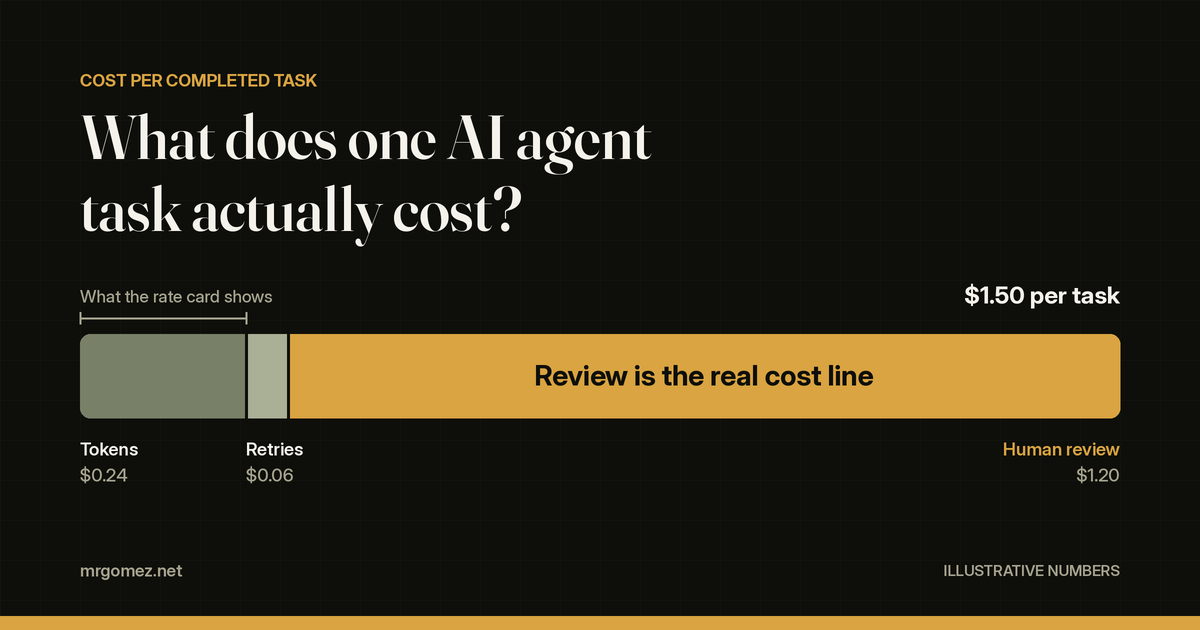
The token-only view. 10,000 tasks × 40,000 tokens = 400 million tokens. At $6 per million, that is $2,400 a month, or $0.24 per task. This is the number that ends up circled on the slide.
Add the retries. 10,000 × 1.25 = 12,500 attempts. 12,500 × 40,000 = 500 million tokens, so the model bill is $3,000 a month, or $0.30 per completed task.
Add the review. 10,000 × 20% = 2,000 reviews. 2,000 × $6 = $12,000 a month, or $1.20 per completed task.
The real number. ($3,000 + $12,000) ÷ 10,000 = $1.50 per completed task.
That is more than six times the token-only figure. Notice where the money went. The model is $0.30 of the $1.50. The other $1.20 is people checking the work.
Against the illustrative human baseline of $15, the agent still looks good. But change one input and watch what happens. If the review rate climbs from 20% to 50%, review cost becomes $30,000, the total becomes $33,000, and cost per completed task more than doubles to $3.30. The token price did not move at all.
There is also a lot this example leaves out on purpose: platform licences, integration work, monitoring, evaluation runs and the cost of the errors nobody caught. Those belong in the business case too. They just do not belong in a per-task number.
The question systems integrators have to answer
There is a growing conversation on X about pricing AI by outcome rather than by token, and it often points back to something Anthropic’s Dario Amodei said on the Dwarkesh Podcast in February. Not every token a model produces is worth the same, he argued. The tokens that tell someone to restart their Mac might be worth “a dollar or a few cents”, while the tokens that tell a pharmaceutical company to move a ring from one end of a molecule to the other “could be worth tens of millions of dollars”. He expects business models that recognise that, including “pay for results” in some form. The practical catch is that outcome pricing needs a baseline and an agreed definition of done.
That is exactly the problem a systems integrator walks into. If an SI charges for time and materials, the client carries all of the retry and review risk. If it charges per completed outcome, the SI carries it. Then the retry rate and the review rate stop being the client’s problem and become the SI’s margin.
So who prices the outcome? Who measures it? And who decides what counts as “completed” when the agent did most of the work and a person signed it off? My view is that SIs that cannot answer those three questions will struggle to charge for agents with any confidence.
I have written before about six agents working one supply chain exception, and about who decides when the system acts. Cost per completed task is the same question in a different currency.
What I’d tell another practitioner
Price the outcome, not the attempt. Build the business case on cost per completed task, with retries and human review included. If your number only has tokens in it, it is a model price, not a business case.
Review is usually the real cost line. In the example above, people checking the work cost four times as much as the model. Bringing the review rate down safely, through better data, clearer instructions and evaluations you trust, will often move the number more than a cheaper model will.
Decide who watches the meter before you go live. Spend caps and kill switches are useful, but they are approximate and someone still has to own them. Agree up front who sets the budget, who gets the alert, and who can switch an agent off.
The rate card tells you what a token costs. Only your own operation can tell you what done costs.
~ Mr. Gómez