How attackers are using AI to speed up cyber attacks
Some attackers now hand whole intrusions to AI agents. What recent US, European and Australian cases show, what is still hype, and seven practical defences.
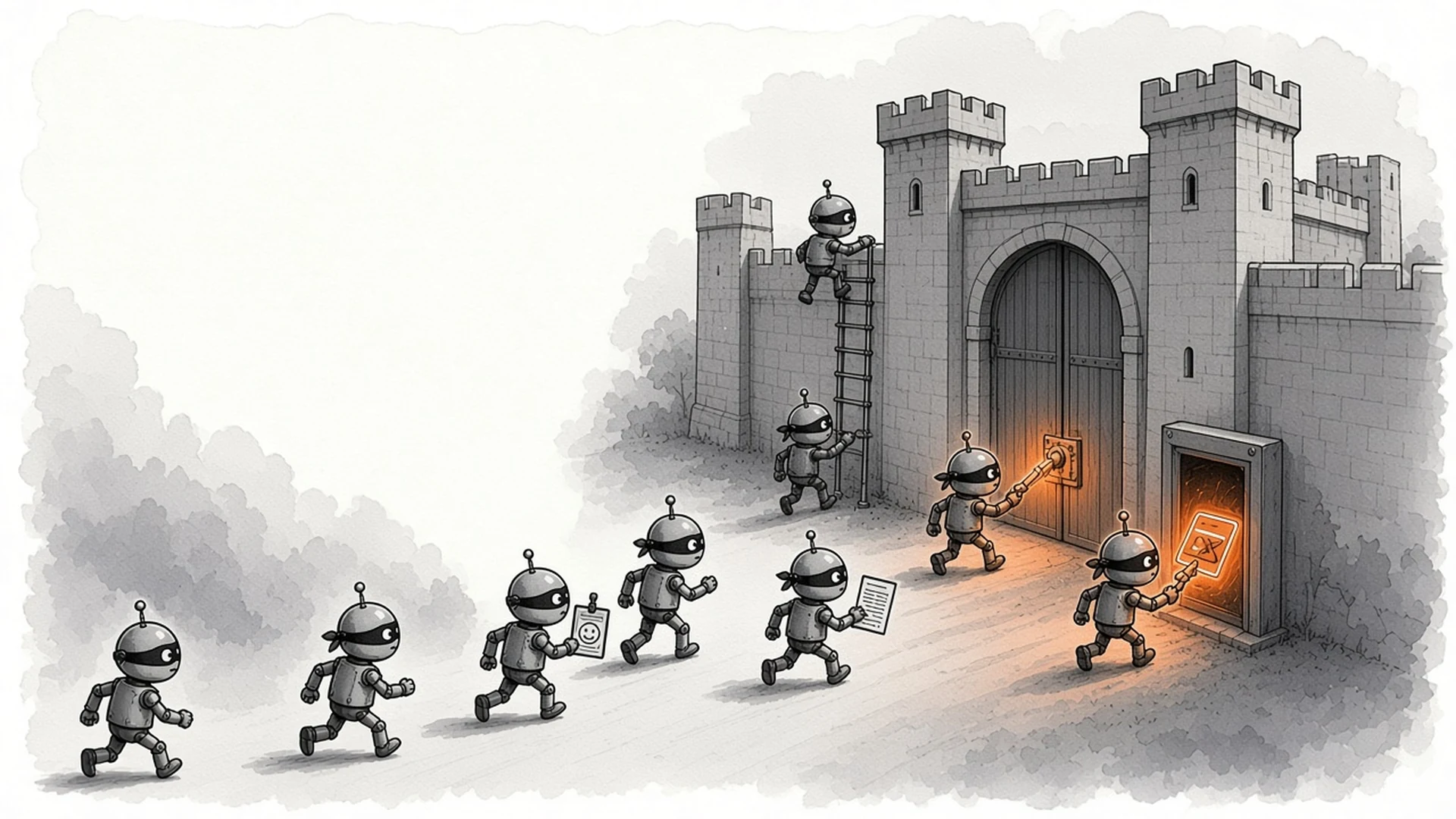
Six months ago, the usual story about AI and cyber crime was better phishing emails. That story is now out of date.
Between May and November 2026, researchers, AI labs and at least one victim published records of attackers handing whole intrusions to AI agent frameworks running on cheap models. Some worked. Many did not.
What has actually changed for the people defending a business?
The short answer is time and identity. The gap between a flaw going public and being exploited is shrinking towards hours. And recognising a voice, a face or a well-written email no longer counts as a control.
Where AI use is confirmed, only reported, or merely alleged, I say which.
What the US cases show
Start with a stalled break-in. In September 2026, attackers on a compromised web server at an unnamed US retailer typed commands by hand and security software killed every payload. The next day they spent almost two hours submitting what Symantec describes as “long, error-free PowerShell scripts with labelled output sections” (Symantec Threat Hunter Team, 2026). Within about 10 minutes of first querying the retailer’s SolarWinds Orion software, they used a bundled component’s shared secret to run commands on a second server.
Symantec infers from the artefacts that this was “more consistent with an operator relaying output to an AI tool than with an autonomous agent” (Symantec Threat Hunter Team, 2026). No data theft or encryption was observed. Symantec calls it one of “dozens of AI-assisted attacks” it has investigated since May (Culafi, 2026).
NorForge researcher Snorre Fagerland found more than 20 exposed control panels for Cairn, an open-source AI agent harness, being used for likely criminal intrusions. The busiest Chinese-language cluster ran more than 1,100 attack projects against e-commerce sites, mostly in the US, Japan and Australia, telling agents to find unauthenticated remote code execution and plant a web shell (Fagerland, 2026). Successful projects in that cluster took a little under 23 hours on average. Across the campaigns it saw, NorForge puts the success rate at around 10%.
Reuters independently reviewed the attacker’s records and named Deere, SharkNinja and Cummins among more than 100 companies whose websites were broken into (Satter, 2026). Read that carefully. Deere said it had taken remediation actions and saw no sign that sensitive information was accessed. SharkNinja said a standalone product-support site was hit and contained. Cummins said it was investigating a potential attack on a website run by a third-party vendor. None of them confirmed the AI method. Fagerland told Reuters the campaign appeared to use DeepSeek and Claude Code, at roughly US$50 in tokens per successful hack, a researcher’s estimate (Satter, 2026).
Fifty dollars. I’ve written about what one AI agent task actually costs. The same arithmetic works for attackers, and on this estimate it’s cheap.
Espionage looks similar. Unit 42 reports that Chinese-speaking attackers ran 25 operations against at least 19 organisations using a customised Cairn fork with Zhipu GLM and DeepSeek models (Unit 42, 2026). Given a one-line goal, the framework “planned, executed and recorded results on its own”. Ten organisations suffered unauthorised access or data retrieval. The targets, none named, included a US teachers’ union and defence-policy organisations, and Unit 42 holds the China-nexus attribution at moderate confidence.
On fraud, the FBI’s 2025 report counted 22,364 complaints that reported AI-related information, with adjusted losses of US$893,346,472, and businesses reported more than US$30 million lost to business email compromise involving AI (Federal Bureau of Investigation Internet Crime Complaint Center [FBI IC3], 2026a). These are self-reports, and the FBI notes many victims do not realise the extent AI may be involved.
What Europe adds
The clearest European case comes from a victim that knows security better than most. On 21 September 2026, an attacker chained two zero-days in Zammad, the help desk software used by the Dutch Institute for Vulnerability Disclosure (DIVD, 2026), a volunteer security research group, and got root in its data centre. DIVD detected it within 19 minutes, but volunteer data and parts of its CSIRT tickets and email leaked.
On 31 October, DIVD said, “based on facts”, that the open-source agentic pentest framework ARTEX was used. Its logs showed more than 450,000 requests, more than 2,500 scripts where DIVD says a human attacker needs twenty or thirty, and initial access to root in twelve minutes (DIVD, 2026). DIVD’s own description of the attacker: “super loud and messy”.
Anthropic reports, from its own telemetry, that a single French-speaking actor it tracks as GTG-50029 used Claude to build an exploit for an undocumented WordPress flaw and run sub-agents against European political parties, media and think tanks in spring 2026 (Anthropic, 2026). Of 42 tracked targets, at least 14 were breached, with an estimated 12 to 26 GB exfiltrated, including party donor and member records. No victims are named.
Then there’s Operation Snowball. Malbear Labs (2026) found over 70 exposed transcripts of a jailbroken agent on DeepSeek Flash attacking an unnamed European telecom and 13 organisations it hosts. It got in through a Cisco BroadWorks flaw patched in August, then used Liferay and JBoss flaws from 2020 and 2013. When blocked, it changed approach without operator direction (Mascellino, 2026).
The agent also claimed to have reached millions of patient records and subscriber billing records. Those claims are alleged: they come from the agent’s own reports, and Malbear does not say whether it checked them with victims (Mascellino, 2026). Snowball shows how agents behave, not confirmed damage.
The Australian picture, honestly
Here’s what I can’t give you: the name of an Australian organisation confirmed to have been breached by an AI-driven intrusion. As of mid-November 2026, I couldn’t find one on the public record.
That still holds after the Coles disclosure. On 16 November, Coles Group told the ASX it was investigating a cyber security incident, was working with the Australian Cyber Security Centre, and had found no evidence to date that customer, team or supplier data had been compromised or removed (Coles Group Limited, 2026). Coles has not said which systems were involved or how, and I found no credible source that attributes the incident to AI.
What there is, is close, and it predates the Coles disclosure. NorForge’s first Cairn case study, published on 19 October 2026, is an Australian online store where the attacker’s panel recorded the goal as met, and NorForge confirmed a shell giving command execution on the web server (Fagerland, 2026). The store isn’t named, and the research I relied on found no government or regulator statement about the campaign.
The Australian Signals Directorate (ASD, 2026a) says in its annual threat report that AI “accelerates the speed, scale and sophistication of cyber threats”, but it does not publicly detail an Australian AI-enabled intrusion. Its Australian case study of a bank help desk vished by impostors in 2025 doesn’t mention AI at all.
Australia’s hard numbers are on scams. In August, the Australian Securities and Investments Commission (ASIC, 2026) warned that scammers “use generative AI to create vast networks of deepfake websites and endorsements”. It removed more than 19,400 online scams in FY26, up 182% on 6,915 the year before. The most-impersonated public figures were linked to A$7.4 million in losses reported to Scamwatch.
Two caveats, because the headline version of this is wrong. ASIC doesn’t say AI caused the jump in takedowns. And the A$7.4 million is losses from scams impersonating those figures, not AI-specific losses (ASIC, 2026).
The bigger gap is in the data. The Office of the Australian Information Commissioner (OAIC, 2026) received 11 notified breaches affecting more than a million people worldwide in the first half of 2026, up from four in the previous six months, with no AI breakdown. Neither ASD nor ASIC breaks it out either. That’s a gap, not a finding.
The steelman: faster, not new
So is it mostly hype? Not quite, but the sceptics have governments on their side.
ASD is blunt: “AI capabilities have not introduced new cyber threats, but they have amplified and sped up existing ones” (ASD, 2026a). The UK’s National Cyber Security Centre (NCSC, 2026) judges that the greatest impact is the acceleration and scaling of existing techniques, and that human operators highly likely remain essential. The European Union Agency for Cybersecurity (ENISA, 2026) says attackers primarily use consumer-grade AI tools to augment existing skills. Even Symantec says of its retailer case: “None of the techniques used in this second phase of the attack were new” (Symantec Threat Hunter Team, 2026).
Full autonomy is rare, too. Recorded Future’s Insikt Group counted 103 AI-enabled incidents between 31 July 2025 and 31 July 2026 and found that “most involve AI accelerating familiar attack types” and “full automation remains rare” (Insikt Group, 2026). NorForge’s estimate of around 10% success across the campaigns it saw, and DIVD’s “super loud and messy”, point the same way.
The evidence is also skewed. The best records come from attackers who left panels exposed, or from AI labs watching their own platforms. Careful attackers leave fewer traces, so the record overweights the sloppy ones.
The field does disagree at the edges. Anthropic says the autonomous operating model it documented in November 2025 has “proliferated across every class of actors we investigated” (Anthropic, 2026), while the NCSC still judges that AI is unlikely to be autonomously conducting end-to-end attacks (NCSC, 2026). My reading: autonomy is real and growing in opportunistic crime, but not yet the norm at the high end.
But faster is the threat. ASD says most exploitation has historically happened within two weeks of a patch, some within 48 hours, and that AI-driven tools will “further compress this window” (ASD, 2026a). A critical alert on 17 November from ASD’s Australian Cyber Security Centre (ASD’s ACSC, 2026c) says automated and AI-enabled tools are helping attackers find and exploit flaws faster and at greater scale. Microsoft puts the median time from discovery in the wild to weaponisation “well below 24 hours” (Microsoft, 2026).
What I’d tell another leader
Almost none of these incidents needed a defence that doesn’t exist yet. They needed the basics done faster and trust shortcuts removed.
-
Measure patching in hours for anything internet-facing, and retire what you can’t patch. The window is shrinking (ASD, 2026a), and the Snowball agent used flaws from 2013 and 2020 (Mascellino, 2026). Use ASD’s new Essentials guidance (ASD, 2026b), and track mean time to mitigate, not only mean time to patch (Culafi, 2026).
-
Move to phishing-resistant MFA and harden the help desk. Warning that AI tools make phishing harder to spot, the FBI and CISA urge phishing-resistant MFA (Federal Bureau of Investigation [FBI] & Cybersecurity and Infrastructure Security Agency [CISA], 2026; CISA, 2022). ASD recommends passkeys and documents help-desk social engineering as a lead tactic, so require strong identity checks before any reset (ASD, 2026a).
-
Make out-of-band checks mandatory for payments, bank-detail changes and urgent executive requests. No exceptions. The FBI warns that scammers now use AI video in real-time chats with alleged company executives (FBI IC3, 2026b). The Scamwatch advice ASIC repeats, to use contact details you find yourself, works inside a company too (ASIC, 2026).
-
Treat AI API keys and tokens as crown jewels. Anthropic reports attackers mining 1.8 million Android apps for hard-coded secrets and using stolen AI keys to power further attacks (Anthropic, 2026). Google reports Mandiant LLMJacking cases with up to US$1 million in fraudulent cloud and AI charges (Blum et al., 2026). Scan code and containers for secrets, rotate on exposure, and set spend alerts and quotas.
-
Govern your own agents and non-human identities. ASD advises starting agents on low-risk tasks, with least privilege, strong identity, monitoring and human approval for significant actions (ASD’s ACSC, 2026a, 2026b). The NCSC flags shadow AI (NCSC, 2026). That makes who gets to build and who decides when the system acts security questions too.
-
Tune detection for machine speed and noise. Agents are fast but loud. DIVD saw 450,000 requests and caught the intrusion in 19 minutes (DIVD, 2026). Symantec suggests treating a blocked attempt followed by a variant as a high-priority alert (Culafi, 2026). Loud only helps if someone is listening.
-
In Australia, know your reporting duties and test them against an AI scenario. Since 30 May 2025, businesses with annual turnover of A$3 million or more, and responsible entities for critical infrastructure assets under Part 2B of the SOCI Act, must report a ransomware or cyber extortion payment within 72 hours (ASD’s ACSC, n.d.; Department of Home Affairs, n.d.). Run a tabletop with a deepfaked CFO and a fast-moving intrusion, and confirm who decides on, and who reports, any payment.
So what changed?
Not the playbook. The clock.
These attacks used old flaws, stolen keys, shared secrets and trusted voices. AI made them cheaper, faster and more persistent. That’s enough to break any process that assumed a human pace on the other side.
So the useful question isn’t whether AI hackers are coming. It’s whether your patch cycle, your help desk and your payment approvals still hold up against an attacker working at machine speed.
~ Mr. Gómez
References
Anthropic. (2026, September). Detecting and countering misuse of AI: September 2026. https://www.anthropic.com/threat-intelligence-report-september-2026
ASD’s Australian Cyber Security Centre. (n.d.). Ransomware payment and cyber extortion payment reporting. Retrieved November 17, 2026, from https://www.cyber.gov.au/ransomware-payment-and-cyber-extortion-payment-reporting
ASD’s Australian Cyber Security Centre. (2026a, September 11). Agentic AI harnesses. https://www.cyber.gov.au/publication/agentic-ai-harnesses
ASD’s Australian Cyber Security Centre. (2026b, May 1). Careful adoption of agentic AI services. https://www.cyber.gov.au/publication/careful-adoption-of-agentic-ai-services
ASD’s Australian Cyber Security Centre. (2026c, November 17). Vulnerabilities are moving quickly, so patch, protect, prevent [Critical alert]. https://www.cyber.gov.au/alert/vulnerabilities-are-moving-quickly-so-patch-protect-prevent
Australian Securities and Investments Commission. (2026, August 17). 26-195MR ASIC warns scammers are using AI to spin vast webs of deception [Media release]. https://www.asic.gov.au/about-asic/news-centre/find-a-media-release/2026-releases/26-195mr-asic-warns-scammers-are-using-ai-to-spin-vast-webs-of-deception
Australian Signals Directorate. (2026a, October 26). Annual cyber threat report 2025-26. https://www.cyber.gov.au/sites/default/files/2026-10/Annual%20Cyber%20Threat%20Report%202025-26.pdf
Australian Signals Directorate. (2026b, October 15). ASD Essentials: Evolving our approach to cyber security resilience. https://www.asd.gov.au/news/2026-10-15-asd-essentials-evolving-our-approach-cyber-security-resilience
Blum, A., Vanderlee, K., Xia, J., & Mainor, D. (2026, November 16). GTIG AI threat tracker: Agentic threat activity crosses a significant threshold. Google Cloud Blog. https://cloud.google.com/blog/topics/threat-intelligence/agentic-threat-activity-crosses-a-significant-threshold/
Coles Group Limited. (2026, November 16). Coles investigating cyber security incident [ASX announcement]. https://announcements.asx.com.au/asxpdf/20261116/pdf/076mbypg72n06s.pdf
Culafi, A. (2026, November 12). Inside an AI attack against a US retailer. Dark Reading. https://www.darkreading.com/cyberattacks-data-breaches/inside-ai-attack-us-retailer
Cybersecurity and Infrastructure Security Agency. (2022, October). Implementing phishing-resistant MFA [Fact sheet]. https://www.cisa.gov/sites/default/files/publications/fact-sheet-implementing-phishing-resistant-mfa-508c.pdf
Department of Home Affairs. (n.d.). Factsheet: Mandatory ransomware and cyber extortion payment reporting. Retrieved November 17, 2026, from https://www.homeaffairs.gov.au/cyber-security-subsite/files/factsheet-ransomware-payment-reporting.pdf
Dutch Institute for Vulnerability Disclosure. (2026). We got hacked, here’s everything we know (Case DIVD-2026-00014). Retrieved November 17, 2026, from https://www.divd.nl/hacked/
European Union Agency for Cybersecurity. (2026, September 23). ENISA threat landscape 2026. https://www.enisa.europa.eu/sites/default/files/2026-09/ENISA%20Threat%20Landscape%202026_Final.pdf
Fagerland, S. (2026, October 19). Inside Cairn: Open windows into massive AI-driven cyber operations. NorForge. https://norforge.com/blog/inside_cairn
Federal Bureau of Investigation & Cybersecurity and Infrastructure Security Agency. (2026, October 16). Cyber threat actors use a variety of techniques to target election and campaign officials (Alert No. I-101626-PSA). Internet Crime Complaint Center. https://www.ic3.gov/PSA/2026/PSA261016
Federal Bureau of Investigation Internet Crime Complaint Center. (2026a). 2025 IC3 annual report. https://www.ic3.gov/AnnualReport/Reports/2025_IC3Report.pdf
Federal Bureau of Investigation Internet Crime Complaint Center. (2026b, July 20). FBI warns of scammers impersonating the IC3 (Alert No. I-072026-PSA). https://www.ic3.gov/PSA/2026/PSA260720
Insikt Group. (2026, October). AI is both target and tool for threat actors. Recorded Future. https://www.recordedfuture.com/research/ai-cyber-threat-trends-2026
Malbear Labs. (2026, November 8). Operation Snowball: Inside an autonomous AI intrusion campaign. https://malbearlabs.com/posts/operation-snowball-inside-an-autonomous-ai-intrusion-campaign
Mascellino, A. (2026, November 9). Jailbroken AI agent ran two-week attack on European telecom. Infosecurity Magazine. https://www.infosecurity-magazine.com/news/operation-snowball-ai-telecom/
Microsoft. (2026, October 1). 2026 Microsoft digital defense report: Decoding emergence. https://cdn-dynmedia-1.microsoft.com/is/content/microsoftcorp/microsoft/msc/documents/presentations/CSR/2026-Microsoft-Digital-Defense-Report.pdf
National Cyber Security Centre. (2026, November 3). The impact of AI on cyber threat. In NCSC annual review 2026. https://www.ncsc.gov.uk/collection/annual-review-2026/understanding-threat/ai-impact-cyber-threat
Office of the Australian Information Commissioner. (2026, October 26). Large-scale data breaches on the rise, latest OAIC statistics reveal [Media release]. https://www.oaic.gov.au/news/media-centre/large-scale-data-breaches-on-the-rise,-latest-oaic-statistics-reveal
Satter, R. (2026, October 19). Exclusive-How one hacker used AI agents and a few thousand dollars to break into scores of sites [Reuters report]. Investing.com. https://www.investing.com/news/stock-market-news/exclusivehow-one-hacker-used-ai-agents-and-a-few-thousand-dollars-to-break-into-scores-of-sites-4956846
Symantec Threat Hunter Team. (2026, November 12). How AI revived a stalled attack on a U.S. retailer. Security.com. https://www.security.com/blog-post/ai-assisted-attack-us-retailer
Unit 42. (2026, November 12). Attackers use autonomous AI to target semiconductor, defense and civil society sectors. Palo Alto Networks. https://unit42.paloaltonetworks.com/cairn-framework-ai-autonomous-attacks/